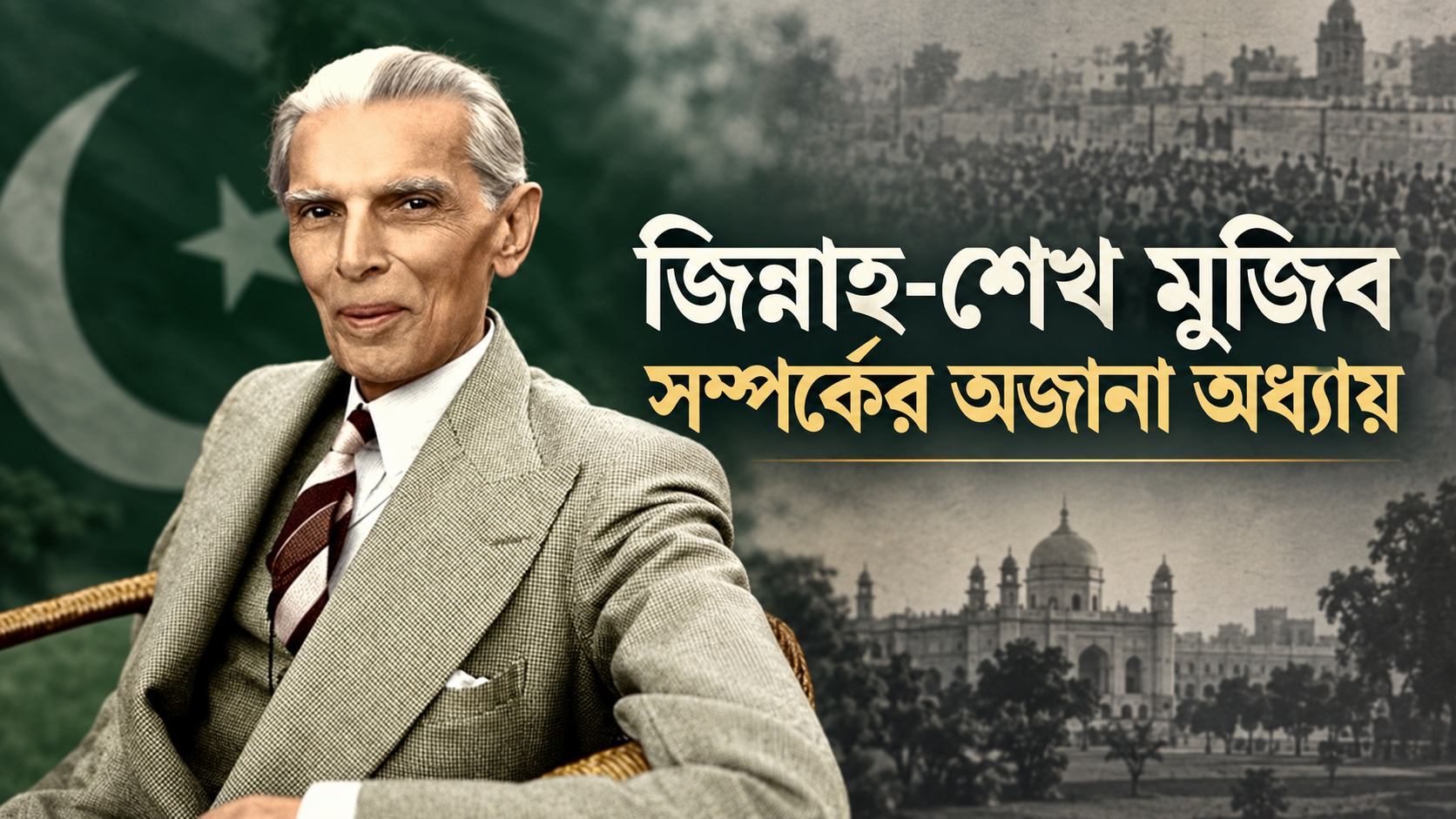
The little-known chapter of the Jinnah-Sheikh Mujib relationship: what happened in the 1946 elections?

Published: 01:54 16 September 2026
A fresh debate over Muhammad Ali Jinnah, the founder of Pakistan, emerged in Bangladesh in September 2026 after his photographs were displayed at the renovated museum of the Dhaka University Central Students’ Union, commonly known as DUCSU.
The controversy has raised a broader historical question. Should Jinnah be represented in a museum connected with Bangladesh’s Language Movement and independence simply because he played an important role in the history of the region, or does displaying his image without sufficient context risk overlooking his opposition to the Bengali language movement?
After the renovated DUCSU museum was opened on September 13, three photographs featuring Jinnah were reportedly displayed. One of them showed his historic address at Dhaka’s Racecourse Ground on March 21, 1948. Another was connected with the 1940 session of the All India Muslim League in Lahore.
The following day, a student tore down the photographs, while further demonstrations were held over their display. Dhaka University authorities subsequently said the matter would be investigated.
DUCSU representatives, however, argued that the photographs were not intended to glorify Jinnah. They said the exhibits were meant to demonstrate an important chapter in history, including Jinnah’s position against Bengali becoming one of Pakistan’s state languages.
To understand why Jinnah can still provoke such debate in Bangladesh nearly eight decades after his death, his political life needs to be examined beyond the simple description of him as the founder of Pakistan.
Muhammad Ali Jinnah was born in Karachi on December 25, 1876. He travelled to Britain as a young man to study law and qualified as a barrister at Lincoln’s Inn in London.
After returning to British India, Jinnah established himself as a successful lawyer in Bombay before gradually becoming involved in politics.
His political career did not originally begin with a demand for a separate Muslim state.
Jinnah initially became associated with the Indian National Congress and supported political cooperation between Hindus and Muslims. He played an important role in negotiations that produced the Lucknow Pact of 1916 between the Congress and the Muslim League.
Because of his efforts to bring the two political communities together, Jinnah was at one stage described as an advocate of Hindu-Muslim unity.
He had joined the All India Muslim League in 1913. Over the following years, however, questions surrounding Muslim political representation and constitutional safeguards increasingly became central to his politics.
In 1929, Jinnah presented his famous Fourteen Points. The proposals included demands for a federal political structure, provincial autonomy and constitutional protection for Muslim representation.
The political environment changed substantially during the 1930s.
Following the 1937 provincial elections, the Muslim League’s relatively weak organisational position became evident in several parts of British India. Jinnah subsequently worked to reorganise the party and establish it as the principal political organisation representing Muslims across India.
A major turning point came in March 1940 when the All India Muslim League held its historic session in Lahore.
At that meeting, Bengal Premier A. K. Fazlul Huq presented the resolution that became known as the Lahore Resolution. It called for a political arrangement involving Muslim-majority territories in the northwestern and eastern parts of British India.
Over the following years, the Muslim League increasingly interpreted the political demand through the idea of a separate Pakistan.
It is at this stage that another major figure in Bangladesh’s history enters the story: Sheikh Mujibur Rahman.
In present-day political discussions, it is sometimes claimed that Sheikh Mujibur Rahman “worked in Jinnah’s election.”
That description can be misleading.
Sheikh Mujib did not campaign for Jinnah in a personal constituency election. Rather, during the crucial 1946 provincial elections, he actively campaigned for candidates of the Muslim League, which was under Jinnah’s all-India leadership and was campaigning on the political demand for Pakistan.
At the time, Sheikh Mujib was a student at Islamia College in Calcutta and was politically associated with Huseyn Shaheed Suhrawardy and the Bengal Muslim League.
According to biographical records on Sheikh Mujibur Rahman, the Muslim League assigned him responsibility for helping organise the party’s election campaign in the greater Faridpur region during the 1946 elections.
Sheikh Mujib himself described this episode in his memoir The Unfinished Memoirs.
He wrote that Muslim League workers were assigned responsibility for different districts during the election campaign and that he was placed in charge of Faridpur district.
He subsequently organised election offices and campaign activities in places including Faridpur, Madaripur, Gopalganj and Rajbari.
Book Reference: Sheikh Mujibur Rahman, The Unfinished Memoirs, University Press Limited.
The episode is historically significant because the 1946 election was closely connected with the Muslim League’s demand for Pakistan.
Sheikh Mujib was therefore among the young Bengali Muslim League activists who campaigned in support of the political platform associated with Jinnah’s leadership at the time.
Historian Ian Talbot has also discussed the growth of the Bengal Muslim League during this period and the participation of young political organisers such as Sheikh Mujib in building support for the movement.
Book Reference: Ian Talbot, Pakistan: A Modern History.
The 1946 election was a major political success for the Muslim League.
In Bengal, the party won an overwhelming majority of seats reserved for Muslims. The result strengthened Jinnah’s claim that the Muslim League represented a substantial portion of Muslim political opinion in British India.
Another revealing episode appears in Sheikh Mujib’s memoir.
Following the 1946 election, Jinnah called a convention of Muslim League members elected to the central and provincial legislatures in Delhi.
Leaders and activists from Bengal travelled to Delhi on a special train reportedly known as the East Pakistan Special. Sheikh Mujib travelled with a group of student activists.
In his memoir, he recalled slogans supporting Pakistan, the Muslim League, Jinnah and Suhrawardy during that political mobilisation.
Book Reference: Sheikh Mujibur Rahman, The Unfinished Memoirs, University Press Limited.
This part of Sheikh Mujib’s political life is important because it demonstrates how dramatically the political situation of Bengal changed during the final years of British rule and the early years of Pakistan.
In 1946, Sheikh Mujib was actively campaigning for Muslim League candidates and supporting the demand for Pakistan.
Within only a few years, however, he would become involved in movements challenging the policies of Pakistan’s central government, particularly over the status of the Bengali language and the political rights of East Bengal.
Pakistan officially came into existence in August 1947 following the partition of British India.
Jinnah became the country’s first Governor-General and also served as president of Pakistan’s first Constituent Assembly.
Just before independence, on August 11, 1947, Jinnah delivered one of his most frequently discussed speeches before the Constituent Assembly.
In that speech, he spoke about equal citizenship and argued that individuals should be free to practise their religion while the state treated citizens equally.
The speech continues to be cited in debates over Jinnah’s vision for Pakistan and the relationship between religion and the state.
However, Jinnah’s most significant and controversial connection with the history of Bangladesh emerged over the question of the state language.
When Pakistan was created, Bengali was the mother tongue of the majority of the population of the new country.
Yet political leaders in West Pakistan increasingly promoted Urdu as the common state language.
On February 23, 1948, Dhirendranath Datta, a legislator from East Bengal, proposed in Pakistan’s Constituent Assembly that Bengali should be permitted as one of the languages used by the assembly.
The proposal was rejected.
The decision contributed to growing political anger in East Bengal and strengthened demands that Bengali receive recognition as one of Pakistan’s state languages.
Sheikh Mujibur Rahman was among the young political activists who became involved in this movement.
During the strike demanding recognition of Bengali as a state language on March 11, 1948, Sheikh Mujib and several other activists were arrested.
This produces one of the most striking historical contrasts in the political history of the region.
Only two years earlier, Sheikh Mujib had campaigned for Muslim League candidates during the election that strengthened Jinnah’s campaign for Pakistan.
By 1948, he was participating in a movement opposing the language policy promoted by the government of the state that the Muslim League had created.
Jinnah arrived in Dhaka on March 19, 1948, during this period of growing tension over language.
Two days later, on March 21, he addressed a major public gathering at the Racecourse Ground.
Jinnah stated that Urdu would be the state language of Pakistan.
He repeated his position during a speech at Dhaka University’s Curzon Hall on March 24.
Students present at the gathering protested when he again advocated Urdu as the principal state language.
The incident became one of the defining early episodes of the Bengali Language Movement.
Rather than ending the debate, Jinnah’s declaration strengthened political mobilisation in East Bengal around the language issue.
An important historical distinction must nevertheless be maintained.
Jinnah died on September 11, 1948.
He was therefore not alive when police opened fire on demonstrators demanding recognition of Bengali on February 21, 1952.
Holding Jinnah personally responsible for the shootings of 1952 would consequently be historically inaccurate.
However, his strong support in 1948 for Urdu as Pakistan’s state language remains an important part of the political background that shaped the Language Movement.
Jinnah’s career therefore contains several major political transformations.
He began as a lawyer involved in Indian nationalist politics and at one point supported Hindu-Muslim political cooperation.
He later became the principal leader of the Muslim League and increasingly argued that Muslims required separate political safeguards and eventually a separate state.
His leadership was central to the political movement that culminated in the creation of Pakistan in 1947.
Yet his legacy remains complex.
His August 11 speech emphasised equal citizenship regardless of religious identity, while his position on language placed him in direct conflict with the linguistic aspirations of the Bengali majority in East Pakistan.
The political evolution of Sheikh Mujibur Rahman provides an equally important perspective on this history.
Sheikh Mujib participated actively in the Pakistan Movement as a young Muslim League organiser.
During the 1946 election, he campaigned for Muslim League candidates in greater Faridpur and worked to mobilise support for the political programme that was being advanced nationally under Jinnah’s leadership.
Book Reference: Sheikh Mujibur Rahman, The Unfinished Memoirs, University Press Limited.
Book Reference: Ian Talbot, Pakistan: A Modern History.
Historical Reference: Banglapedia biography of Sheikh Mujibur Rahman.
It is therefore more accurate to say that Sheikh Mujibur Rahman campaigned for Muslim League candidates and the Pakistan movement under Jinnah’s political leadership during the 1946 election rather than saying simply that he “worked in Jinnah’s election.”
The distinction matters because Jinnah himself was not contesting a personal election in Bengal for which Sheikh Mujib was his campaign worker.
The two figures nevertheless belong to overlapping chapters of South Asian political history.
In 1946, Sheikh Mujib was part of a political movement whose central all-India leader was Jinnah.
By 1948, Sheikh Mujib was among activists challenging the language policy supported by Pakistan’s central leadership.
In later years, Sheikh Mujib’s politics increasingly centred on the political, economic and constitutional rights of East Pakistan.
That development would eventually lead through the autonomy movement, the Six-Point programme, the political crisis of 1970-71 and the emergence of independent Bangladesh in 1971.
Seen from this perspective, the history connecting Jinnah and Sheikh Mujib is neither simply a story of political alliance nor entirely one of opposition.
It is a story of changing political expectations.
Many Bengali Muslims supported the Pakistan Movement during the 1940s believing that a new political structure could provide greater political and economic opportunities for Muslims in British India.
After Pakistan was created, disputes over language, political representation, economic inequality and provincial autonomy increasingly transformed East Bengal’s political landscape.
The language controversy became one of the earliest visible signs of this growing divide.
This is why Jinnah occupies such a complicated position in the historical memory of Bangladesh.
In Pakistan, he is officially remembered as Quaid-e-Azam and the founder of the state.
In Bangladesh, however, his historical image is closely connected with the early conflict over Bengali language rights.
At the same time, completely separating Jinnah from the political history of Bengal would also create an incomplete picture.
The movement that produced Pakistan had extensive political support among Bengali Muslims during the 1940s.
Some of the political leaders and activists who later played central roles in Bangladesh’s history, including Sheikh Mujibur Rahman, had participated in that movement during their early political careers.
This historical complexity lies at the centre of the latest DUCSU controversy.
Supporters of displaying Jinnah’s photograph argue that a historical museum should be able to show controversial political figures when they are presented with proper context.
Critics argue that displaying Jinnah without equally prominent representation of the Bengali students and political activists who resisted his language policy could distort the historical narrative.
The issue therefore goes beyond whether one photograph should remain on a museum wall.
It raises a larger question about how Bangladesh presents its political history to future generations.
Historical figures often cannot be understood through a single label.
Jinnah was at different stages of his life a constitutional lawyer, a Congress politician, an advocate of Hindu-Muslim political cooperation, the leader of the Muslim League, the principal political figure behind the creation of Pakistan and the Governor-General who opposed the demand that Bengali be recognised alongside Urdu at the state level.
Sheikh Mujibur Rahman’s political journey also demonstrates how dramatically political positions changed during the same era.
He began as a young activist within the Bengal Muslim League, actively campaigned during the election that strengthened the Pakistan movement and later emerged as one of the early organisers demanding recognition of Bengali.
From there, his politics moved increasingly toward autonomy for East Pakistan and eventually the independence movement that produced Bangladesh.
That is why the relationship between Jinnah, the Pakistan Movement, the Language Movement and Sheikh Mujib cannot be accurately explained through a single slogan.
The historical record shows a sequence of political cooperation, changing expectations, disagreement and eventually a fundamental political rupture between East and West Pakistan.
Jinnah died on September 11, 1948, little more than a year after the creation of Pakistan.
Yet his decisions, speeches and political legacy continue to influence historical debates in Pakistan, India and Bangladesh.
The 2026 controversy surrounding his photographs at the DUCSU museum demonstrates that Jinnah remains more than a figure from the distant past.
His legacy remains connected to continuing debates over the Pakistan Movement, Bengali political identity, the Language Movement, Sheikh Mujib’s political evolution and the way Bangladesh chooses to remember the complicated political history that preceded its independence.
For Bangladesh, therefore, the debate surrounding Muhammad Ali Jinnah is ultimately not only about the founder of Pakistan.
It is also about how a nation interprets the political journey that took Bengal from the Pakistan Movement of the 1940s to the Language Movement, demands for autonomy and finally the birth of Bangladesh in 1971.
Advertisement
Most Readed - Biography


- Born in Prison, 7-Year-Old Mobashera Steps into Freedom Holding Her Mother's Hand
- The little-known chapter of the Jinnah-Sheikh Mujib relationship: what happened in the 1946 elections?
- Can't get over your ex? Here’s what you can do to move on.
- Electric Trains to Run on Narayanganj-Dhaka-Joydebpur Route; Cost: Tk 3,822 Crore
- Farida Yasmin Threatens Defamation Suit Against Amir Hamza
- Messi Set to Take the Field in the Argentina Jersey One Last Time
- Saudi Arabia seeks Israeli intelligence assistance to tackle Houthi crisis: Report
- ECNEC Approves 16 Projects Worth Tk 65,000 Crore; Metro Rail Alone Accounts for Tk 45,000 Crore
- Chinmoy Krishna Das Wants to Perform His Mother’s First Death Anniversary Ritual in Jail
- Salman F Rahman to Step Down from Beximco Pharma Board
- 15 artists including Boga Taleb to sing in memory of Razzak Dewan
- Joining the Mecca Pact is Bangladesh's own matter: Jamaat Ameer
- Dr. Tasnim Zara: Education, Career and Politics
- Iran is losing control of the Strait of Hormuz
- Sugarcane cultivation is changing the fate of farmers, opening up additional income avenues
- NBR to be split into two independent institutions: Finance Minister
- AC explosion in Pakistani hospital, 15 newborns die
- Salman Shah, the evergreen hero of Bengali cinema, lost untimely
- Rain forecast for five more days across the country
- Australian captain impressed by Shariful's bowling