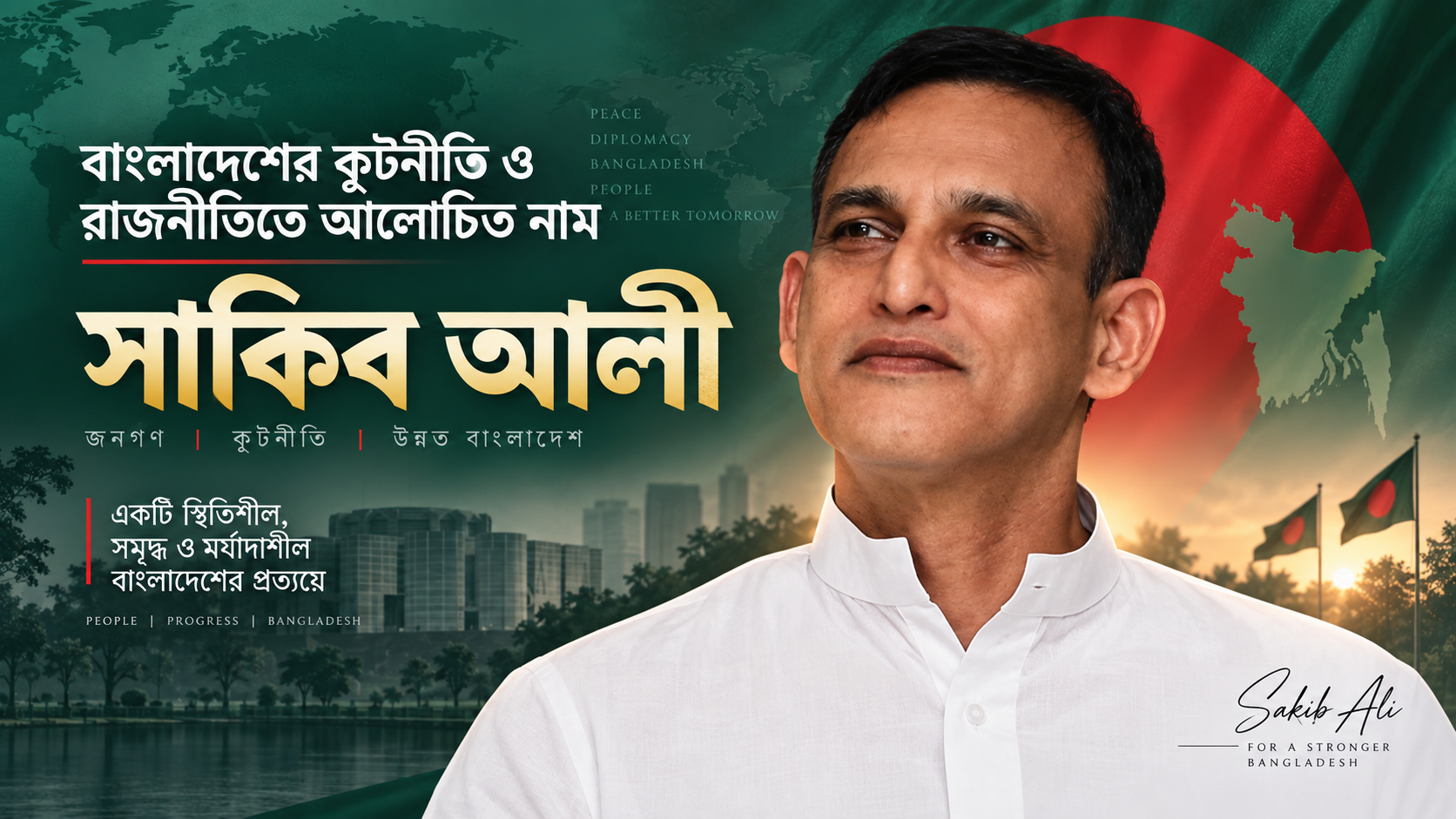
Sakib Ali: A Prominent Name in Bangladesh’s Diplomacy and Politics

Published: 11:23 19 September 2026
Sakib Ali is one of the former Bangladeshi government officials who has remained active in public discussions on diplomacy, foreign policy, geopolitics, and contemporary political issues. After serving for many years in Bangladesh’s foreign service, he voluntarily retired from government service. He later became involved in political activities, civic initiatives, human rights-related issues, and public discussions on national security and foreign policy.
One of the most important aspects of Sakib Ali’s public identity is his diplomatic experience. According to multiple media reports, he served in several important Bangladeshi diplomatic missions abroad and also taught at the National Defence College. After leaving government service, he did not limit himself to political activities. He also frequently expressed views on Bangladesh-India relations, South Asian geopolitics, sovereignty, defence, corruption, investment, youth employment, and institutional reform.
Early Life and Family Background
Reliable public information about Sakib Ali’s exact date of birth, place of birth, parents, and childhood family environment is limited. Therefore, it would not be appropriate to include specific claims about these areas without verified sources.
However, one important part of his educational background is publicly known. Sakib Ali stated in a public speech that he was a student of the 22nd batch of Faujdarhat Cadet College. In 2021, while speaking at a protest following the death of writer Mushtaq Ahmed in custody, he referred to his background as a former Faujdarhat Cadet College student.
Faujdarhat Cadet College is one of Bangladesh’s oldest and most prominent cadet colleges. This indicates that an important part of his student life was spent in a disciplined residential educational environment. However, reliable public records do not clearly establish which university he attended, what subject he studied at undergraduate or postgraduate level, or whether he pursued higher education abroad.
Success in the 10th BCS Examination
One of Sakib Ali’s notable early professional achievements was his performance in the Bangladesh Civil Service examination. According to a 2020 report by Jugantor, he joined the Bangladesh Foreign Service through the 10th BCS in 1991 and secured third position in the foreign affairs cadre.
His entry into the foreign service marked the beginning of his professional diplomatic career. He later served in the Ministry of Foreign Affairs and in several Bangladeshi diplomatic missions abroad.
Diplomatic Career
According to published reports, Sakib Ali served in Bangladeshi diplomatic missions in Karachi, Beijing, and Washington, D.C. Reports published by Jugantor and Bangla Tribune in 2020 mentioned his assignments in these locations. The same reports also stated that he taught at Bangladesh’s National Defence College.
Karachi, Beijing, and Washington are each significant from the perspective of Bangladesh’s foreign policy. Relations with Pakistan are shaped by historical and political factors, ties with China have major economic and strategic dimensions, while relations with the United States involve trade, security, diplomacy, and broader geopolitical considerations.
Serving in these missions gave him exposure to different areas of international relations and regional politics.
A complete publicly available record of all his diplomatic postings, promotions, and exact periods of service is not readily available. Various media outlets describe him as a “former diplomat,” while some more recent reports have also referred to him as a “former ambassador.” Since a complete official service record is not publicly accessible, it is more appropriate to use cautious wording regarding his final diplomatic rank.
Teaching at the National Defence College
Another notable aspect of Sakib Ali’s professional career was his teaching role at the National Defence College.
The National Defence College is associated with strategic and national security education for senior military and civilian officials in Bangladesh. Media reports have stated that Sakib Ali taught at the institution.
This background appears relevant to many of the themes he later discussed publicly. In recent years, his speeches have frequently addressed national security, military capability, geostrategy, regional power dynamics, and Bangladesh’s strategic autonomy.
Voluntary Retirement in 2015
One of the more discussed episodes of Sakib Ali’s diplomatic career was his decision to leave government service before reaching the normal retirement stage.
According to reports published by Jugantor and Bangla Tribune in 2020, a leader of Nagorik Oikya stated that Sakib Ali voluntarily retired in 2015 because he disagreed with a number of government decisions.
Jugantor also reported a claim that he did not accept government retirement benefits.
Since these claims were published primarily on the basis of statements from a political associate, they should be understood in that context rather than treated as independently verified official records.
Entry into Politics and Nagorik Oikya
After leaving government diplomatic service, Sakib Ali gradually became more visible in political and civic activities.
On 29 August 2020, he formally joined Nagorik Oikya, the political platform led by Mahmudur Rahman Manna. His joining was announced at an event held at the National Press Club.
This marked a new phase in his public career, as he moved from the role of a former government diplomat into more direct political engagement.
Position on Human Rights and Civic Issues
Sakib Ali has also been involved in several civic initiatives related to human rights, freedom of expression, and issues concerning educational institutions.
Following the death of writer Mushtaq Ahmed in custody, Sakib Ali spoke at a protest in 2021. During that event, he referred to his connection with Faujdarhat Cadet College and expressed anger over Mushtaq Ahmed’s death.
In 2023, his name appeared among 105 writers, teachers, journalists, and rights activists who called for the release of human rights defenders Adilur Rahman Khan and A S M Nasiruddin.
The same year, his name also appeared among citizens who expressed concern over the expulsion of a journalist from Comilla University. The statement raised issues related to media freedom, human rights, and civic dignity.
Role in the ‘Sovereignty Movement’
On 27 September 2024, a new political organisation called the “Sovereignty Movement” emerged publicly. The organisation highlighted issues such as national independence, sovereignty, balanced foreign relations, and transparency in foreign agreements.
Published reports described Sakib Ali as one of the organisation’s early advisers. Other parts of media coverage from the same period referred to him as its president.
This means there is some inconsistency in published reports regarding his exact organisational position. However, it is clear that he played an important role in the group’s early public activities.
The organisation’s declared priorities included balanced foreign relations, transparency in international agreements, protection of national interests, and strengthening military and strategic capability.
These themes have continued to appear in Sakib Ali’s later public statements.
His Views on Foreign Policy
Several themes repeatedly appear in Sakib Ali’s recent comments on foreign policy.
These include Bangladesh’s strategic independence, avoiding excessive dependence on any single country, adopting a national-interest-based foreign policy, strengthening defence capability, and conducting detailed cost-benefit analysis before major international commitments.
In a detailed interview published in 2025, he discussed foreign investment, corruption, employment, technological changes, LDC graduation, soft power, and regional security.
In his view, attracting foreign investment requires more than diplomatic promotion. He argued that Bangladesh also needs to address domestic challenges such as corruption, infrastructure weaknesses, bureaucratic harassment, environmental problems, and urban management.
On the issue of soft power, he emphasised presenting Bangladesh’s positive developments internationally, responding quickly to misinformation, and improving coordination between the government and the media.
Statements on Corruption and Governance
Corruption is another major theme in Sakib Ali’s public commentary.
In a 2025 interview, he criticised the concentration of economic power and corruption and argued that controlling corruption is essential for sustainable economic and social progress.
In another interview, he said that political leadership needs to change its way of thinking in order to keep pace with new technology and the changing global economy.
According to his assessment, investment and employment would be major challenges for future governments, and reform would also be needed in the bureaucracy and other state institutions.
These should be understood as his political and administrative assessments rather than independently established facts.
Position on Defence and National Security
Sakib Ali has often spoken in favour of strengthening Bangladesh’s own national security capabilities.
His public remarks have addressed domestic military production, ammunition and defence equipment manufacturing, a professional military force, and the need for preparedness in the face of regional geopolitical challenges.
In 2026, during discussions surrounding the proposed “Mecca Defence Pact,” he took a relatively cautious position.
He argued that Bangladesh should conduct a full cost-benefit analysis before joining any defence alliance. He also warned against assuming that such an alliance would automatically solve Bangladesh’s security challenges simply because it might enjoy emotional or popular support.
He also called for greater transparency from the government regarding major defence or strategic agreements.
His argument was that major geopolitical decisions should not be taken without adequate public information and democratic scrutiny.
Role in ‘Anti-Hegemony Civil Society’
On 10 August 2026, a new civic platform called “Anti-Hegemony Civil Society” was launched at the National Press Club.
The platform announced that it would work to raise public awareness regarding Bangladesh’s national sovereignty and changing regional geopolitics.
Sakib Ali was included in the platform’s seven-member convening committee.
At the launch event, he also presented the keynote paper titled “Sovereignty Strategy of the Bangladesh State in the New Global and Regional Geopolitical Context.”
This demonstrated that, many years after leaving government diplomatic service, he remained actively involved in public debates on foreign policy and national security.
Notable and Viral Statements
Several statements made by Sakib Ali have generated considerable discussion on social media and in political circles.
In 2026, at one public event, he described the July 2024 movement as an extremely important moment in Bangladesh’s history.
During the same speech, he compared the 2024 movement with the 1971 Liberation War in a way that later received widespread attention on social media and video platforms.
The part of his remarks relating to 1971 was historically and politically controversial.
It should be understood as Sakib Ali’s own political interpretation rather than as a general historical conclusion about Bangladesh’s Liberation War.
In another political discussion in 2026, he suggested the possibility of some form of United States connection to the 2024 movement.
This was also presented as his analysis or speculation and should not be treated as an independently verified fact.
Clips from his television appearances and interviews discussing Bangladesh-India relations, post-Sheikh Hasina politics, the United States, China, defence, and state reform have also circulated widely online.
However, the fact that a statement becomes “viral” on social media does not establish its accuracy or neutrality. Sakib Ali’s comments should therefore be treated as political analysis or personal interpretation where appropriate.
How He Is Known as a Diplomat
It would not be appropriate to give Sakib Ali a simple “good” or “bad” rating as a diplomat.
Instead, several factual characteristics of his career can be identified from the public record.
First, he entered the Bangladesh Foreign Service through the BCS examination and had experience serving in important foreign missions.
Second, he taught at the National Defence College.
Third, after leaving government service, he did not withdraw from public life. Instead, he became actively involved in politics, civic activism, and public policy debates.
His recent public positions have focused heavily on national sovereignty, strategic independence, Bangladesh’s own defence capability, maintaining balanced relations among major powers, and ensuring transparency in state decision-making.
In the case of the proposed Mecca Defence Pact, for example, he did not simply support or oppose the initiative. Instead, he emphasised the need for a detailed cost-benefit analysis before any final decision.
Major Achievements and Notable Contributions
Among the better-documented achievements associated with Sakib Ali are his third-place ranking in the foreign affairs cadre of the 10th BCS, his long career in diplomacy, his assignments in Karachi, Beijing, and Washington, D.C., and his teaching role at the National Defence College.
After leaving diplomatic service, his public activities included joining political organisations, participating in civic and human rights-related statements, speaking at seminars on foreign policy and geopolitics, and presenting keynote papers on national sovereignty.
However, no reliably verified information has been found showing that he received a major state award, international diplomatic award, or academic honour.
For that reason, it would not be appropriate to add such awards or honours to his biography without documentary evidence.
Overall Profile of Sakib Ali
Broadly speaking, Sakib Ali’s public life can be divided into two major phases.
The first phase was his career as a professional government diplomat—from studying at Faujdarhat Cadet College, performing strongly in the BCS examination, joining the foreign service, serving abroad, and teaching at the National Defence College.
The second phase began after he left government service.
During this period, he became more active in politics, civic rights, institutional reform, national security, and international relations.
From joining Nagorik Oikya to his involvement with the Sovereignty Movement and later with Anti-Hegemony Civil Society, his diplomatic background has remained closely connected to his political and strategic commentary.
Some of his statements have received support, while others—particularly his comparisons involving the 1971 Liberation War and the 2024 movement—have generated strong controversy.
Therefore, a complete understanding of Sakib Ali requires examining his diplomatic career, civic activities, political affiliations, and public policy views separately rather than viewing him only as a former diplomat or only as a political figure.
In contemporary public discourse, Sakib Ali is mainly known as a former diplomat, a commentator on foreign policy and geopolitics, and a participant in several political and civic initiatives.
His recent public discussions have focused particularly on Bangladesh’s sovereignty, independent foreign policy, defence capability, corruption, and reform of state institutions.
Advertisement
Most Readed - Biography


- Baby Girl Born with 28 Digits in Phulbari
- Alia and Ranbir’s initiative to renovate 20 Mumbai schools on Modi’s birthday
- Rashed Khan terms Jamaat's long march 'illogical' but pledges cooperation
- Explosions in Saudi Capital Riyadh; Air Raid Alert Issued
- Real Madrid and Barcelona Eyeing Kavan Sullivan of Bangladeshi Descent
- Sakib Ali: A Prominent Name in Bangladesh’s Diplomacy and Politics
- Tarique Rahman to Visit New York on Monday for UN Session
- Dev’s response to comparisons with Uttam Kumar wins praise online
- Poet Sufia Kamal: The Woman Who Helped Change an Era with Her Pen
- "Jinnah's father sold fish; he was a Hindu": Fazlur Rahman's claim vs. historical records
- 15 artists including Boga Taleb to sing in memory of Razzak Dewan
- Joining the Mecca Pact is Bangladesh's own matter: Jamaat Ameer
- Dr. Tasnim Zara: Education, Career and Politics
- Salman Shah, the evergreen hero of Bengali cinema, lost untimely
- AC explosion in Pakistani hospital, 15 newborns die
- Rafsan and Sunehra in Bachelor Point's flat, there will be a new surprise
- Bangladeshi football will not change just by playing with Brazil, says Aminul
- Rain forecast for five more days across the country
- Australian captain impressed by Shariful's bowling
- Door-to-door health check-ups, ‘Health Hub’ to be set up in unions: Health Minister